Friday, June 8, 2018

Scoop: Mueller's interest in a mysterious White House visitor


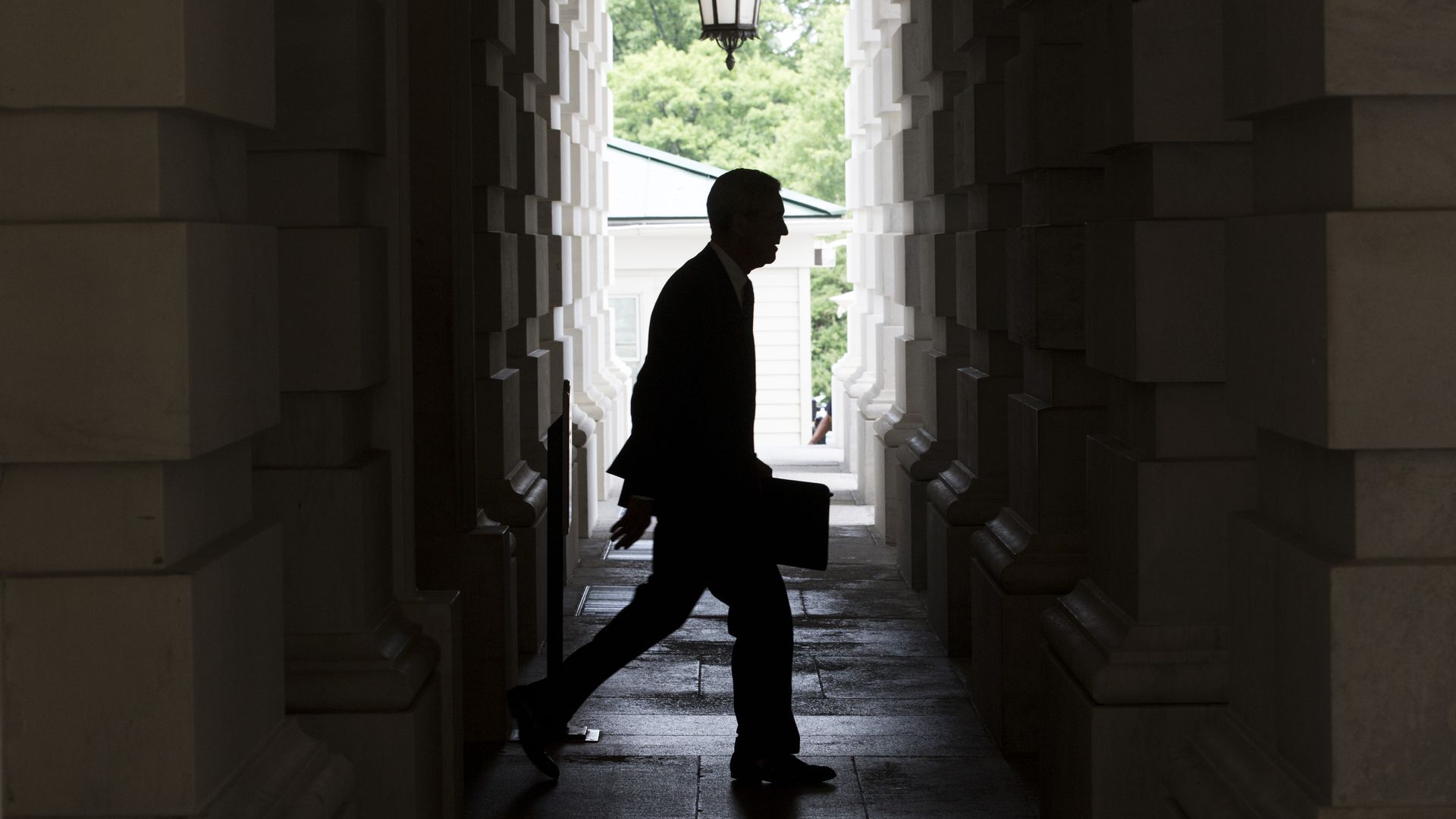
Mueller, silhouetted, leaves the U.S. Capitol building after a meeting. Photo: Zach Gibson / Bloomberg via Getty Images

Special Counsel Robert Mueller's team has been talking with George Nader, a little-known Bannon associate who boasts of his well-placed connections in the Middle East, Axios has learned.

Nader has spoken with Mueller's team at least twice, according to a source briefed on the investigation. A second source briefed on the investigation confirmed that Mueller's team has brought Nader in for questioning in the past week. The Special Counsel's office declined to comment.

Via Axios

Thursday, June 7, 2018

The dealmaker: Mueller witness helped broker $4.2 billion Iraq-Russia arms deal


ARTICLE SUMMARY
Special Counsel Robert Mueller’s latest interest, Lebanese-American businessman George Nader, has a long history of mysterious dealings in the Middle East despite a low profile in Washington.

A Lebanese-American businessman reported to be cooperating with Special Counsel Robert Mueller’s Russia probe helped broker a controversial 2012 Iraq-Russia arms deal valued at $4.2 billion, Iraqi sources tell Al-Monitor.

Russia arms deal

George Nader, 58, traveled to Moscow in 2012, telling Russian interlocutors that he represented Iraqi Prime Minister Nouri al-Maliki and the deal should be negotiated through him, according to two Iraqi sources. Nader’s role in the deal was controversial to Iraqi officials because Iraq’s minister of defense was in Russia to conduct the negotiations, and they were unaware that Maliki was working with Nader to bypass official channels.

One of the Iraqi sources, a former Iraqi official who spoke to Al-Monitor on condition that he not be named, personally witnessed Nader’s interactions with Maliki in their Moscow hotel when he accompanied Maliki to Moscow in October 2012 to sign the arms deal with Russian President Vladimir Putin.

Nader’s career as a deal broker in Iraq ran from the mid-2000s until Maliki left office in 2014, the Iraqi sources said. Nader then became an adviser to the powerful Abu Dhabi Crown Prince Mohammed bin Zayed Al Nahyan. It is in that capacity that Nader’s meetings with members of the incoming Donald Trump administration in 2016-17 — including Trump's son-in-law Jared Kushner, former national security adviser Michael Flynn and former chief strategist Steve Bannon — brought Nader to Mueller’s attention.

The New York Times reported Tuesday that Nader was arrested and questioned by the FBI when he landed at Washington Dulles International Airport on Jan. 17 en route to celebrate Trump’s first year in office at Mar-a-Lago in Florida. He was questioned by Mueller’s grand jury March 2 and is reported to now be cooperating with Mueller’s probe. One line of inquiry Mueller is reported to be questioning Nader about is whether the United Arab Emirates (UAE) might have funneled money to members of the incoming Trump administration in an effort to curry influence with them, including in their dispute with Qatar.

From journalist to dealmaker

Nader’s recent career as a Middle East deal broker is both an outgrowth and departure from his past. As an editor of Middle East Insight magazine in Washington in the 1980s and 1990s, Nader interviewed President Bill Clinton and Iranian Supreme Leader Ayatollah Ruhollah Khomeini.

During this time, Nader also served as a frequent go-between in informal Syrian-Israeli talks encouraged by the Clinton administration before abruptly disappearing from the Washington scene around 2000.

“He was a reliable go-between, a facilitator,” Martin Indyk, who knew Nader when Indyk served as Clinton’s assistant secretary of state for Near East affairs and ambassador to Israel in the 1990s, told Al-Monitor. “He was not a con man.”

Nader was connected to the Hafez al-Assad regime through then-Syrian Foreign Minister Farouk al-Sharaa and then-Syrian Ambassador to the United States and current Foreign Minister Walid Moallem, Indyk said. “He was going to Israel from time to time. He set up an interview of [Syrian Foreign Minister al-Sharaa] with Israeli journalist Ehud Yaari as a confidence-building measure. George is the one that made that happen. … Then he hooked up with [Ron] Lauder. He traveled with Lauder 16 times to Damascus in 1998” in efforts to advance an Israeli-Syrian peace agreement.

“And then when the Clinton administration was gone, George was gone,” Indyk, now executive vice president of the Brookings Institution, said.

“Last time I heard from [Nader] was after the US invasion of Iraq,” journalist Hisham Melham told Al-Monitor. “He called me from Kurdistan. But why would MBZ [the crown prince] need him when he has [UAE Ambassador] Yousef Al Otaiba?”

From dabbling in Syria-Israel peace talks to Iraq postwar dealmaker

Nader appeared in Iraq in the mid-2000s, looking to translate his Rolodex of connections from his Middle East Insight days into work advising various Iraqi political clients, including some of Iraq’s new Shiite political leaders, as well as Kurdish officials.

According to Iraqi sources, Nader helped arrange meetings for the 2005 visit to Washington of leading members of an Iraqi Shiite political party with close ties to Iran, the Supreme Council for the Islamic Revolution in Iraq. In 2010, Nader similarly arranged meetings for then-Iraqi Kurdistan Regional Government (KRG) Prime Minister Nechirvan Barzani with high-level UAE officials, including the crown prince, a second Iraqi source now living in exile told Al-Monitor. But Nader failed to win over the KRG leader, the second Iraqi source said.

“Nader got Nechirvan Barzani meetings with MBZ and [Lebanese Prime Minister] Saad Hariri,” the second Iraqi source said, adding that he advised Iraqi Kurdish interlocutors at the time to be wary of Nader.

Nader had a “knack for claiming that he had unique access to 'mysterious' persons,” the second Iraqi source said. “This way he would be able to latch on from one new confidant to another.”

By 2012, Nader had forged close ties with the Iraqi prime minister and Maliki’s son and deputy chief of staff, Ahmed Maliki, Iraqi sources said. Nader had worked with the younger Maliki on power generation projects, the former Iraqi official said. The relationship that Nader forged with Maliki’s son apparently brought Nader into the father’s inner circle when the huge Russian arms deal was being negotiated.

In August 2012, Iraq’s Minister of Defense Saadoun al-Dulaimi spent 24 days in Moscow to finalize negotiations for the $4.2 billion Russian arms deal. But during the negotiations, the former Iraqi official told Al-Monitor that he received a message from former Russian Energy Minister Yuri Shafranik warning him that there were other people in Moscow claiming that they, and not the defense minister, were representing Maliki, and that the deal should go through them.

Eventually, on Oct. 3, 2012, Shafranik went to Baghdad to try to clarify the situation with Maliki, the former Iraqi official said. Shafranik even offered Maliki a direct communication line with Russian President Vladimir Putin to avoid confusion and leaks.

“The third of October, Yuri [Shafranik] came to Baghdad, met the prime minister and told him clearly that ‘Mr. Putin is suggesting direct relations between you and him to avoid any leakage and … cut any unhealthy things,’” the former Iraqi official said. “The prime minister welcomed that.”

Maliki assured the officials that he welcomed the suggestion to streamline their contacts and signaled that the confusion over who represented Baghdad in the arms deal would be resolved.

So the former Iraqi official was astonished when he accompanied Maliki to Moscow in October 2012 to sign the Russian arms deal to see Nader enter their hotel and take the elevator to Maliki’s suite.

“We were in a Radisson hotel in Moscow,” the former Iraqi official said. “And all of a sudden, George Nader came, walking very fast, entered the elevator, went up and, I saw from the screen over the elevator, went to the level where the prime minister was staying.

“When the minister of defense came down to the ground floor, I asked, did you notice George Nader? And he said yes; he saw him entering the prime minister’s suite,” the former Iraqi official said. “By that time I realized the issue is in-house. The corrupted party, which went to Moscow to represent Maliki, they are not … strange people. They are in the circle with Maliki.”

The former Iraqi official continued, “Also, while we were there we discovered new facts. I myself did not know that those people who traveled to Moscow at the end of August, that they are connected to Maliki and his son. But George Nader I knew very well. I was shocked. Then it immediately came to me — Nader’s relations with the son of Maliki.”

Over the course of the trip to Moscow, “we came to know that one of the three people who had been in Moscow presenting themselves as [Maliki’s] representative was George Nader,” the former Iraqi official said.

A call Wednesday by Al-Monitor to an attorney who represented Nader in an earlier case was not returned. A spokesman for the Iraqi Embassy said it did not have information on the matter.

The Iraqi-Russian arms deal was controversial in Iraq and long suspected to have involved corruption. In November 2012, just a month after it was signed, Iraq’s then-acting Defense Minister Dulaimi announced that the deal was canceled, “citing possible corruption in the contract,” Reuters reported.

But Maliki’s then-media adviser Ali al-Moussawi was cited by Reuters as saying that the deals would be renegotiated and any suspension of the contract was “a precautionary measure because of suspected corruption."

From Iraq to the UAE

After the end of Maliki’s run as Iraq's prime minister in 2014, Nader made his way to become an adviser to the Abu Dhabi crown prince. Until Trump’s election, however, he had maintained such a low profile that even several Washington consultants who have advised the Emirates said they were entirely unaware of his role.

It may now be left to Mueller to help deepen understanding of Nader’s mysterious activities and what role they may have played in influencing the Trump administration’s policies toward the Middle East.

Trump Jr. and Other Aides Met With Gulf Emissary Offering Help to Win Election


WASHINGTON — Three months before the 2016 election, a small group gathered at Trump Tower to meet with Donald Trump Jr., the president’s eldest son. One was an Israeli specialist in social media manipulation. Another was an emissary for two wealthy Arab princes. The third was a Republican donor with a controversial past in the Middle East as a private security contractor.

The meeting was convened primarily to offer help to the Trump team, and it forged relationships between the men and Trump insiders that would develop over the coming months — past the election and well into President Trump’s first year in office, according to several people with knowledge of their encounters.

Erik Prince, the private security contractor and the former head of Blackwater, arranged the meeting, which took place on Aug. 3, 2016. The emissary, George Nader, told Donald Trump Jr. that the princes who led Saudi Arabia and the United Arab Emirates were eager to help his father win election as president. The social media specialist, Joel Zamel, extolled his company’s ability to give an edge to a political campaign; by that time, the firm had already drawn up a multimillion-dollar proposal for a social media manipulation effort to help elect Mr. Trump.

The company, which employed several Israeli former intelligence officers, specialized in collecting information and shaping opinion through social media.


It is unclear whether such a proposal was executed, and the details of who commissioned it remain in dispute. But Donald Trump Jr. responded approvingly, according to a person with knowledge of the meeting, and after those initial offers of help, Mr. Nader was quickly embraced as a close ally by Trump campaign advisers — meeting frequently with Jared Kushner, Mr. Trump’s son-in-law, and Michael T. Flynn, who became the president’s first national security adviser. At the time, Mr. Nader was also promoting a secret plan to use private contractors to destabilize Iran, the regional nemesis of Saudi Arabia and the Emirates.

After Mr. Trump was elected, Mr. Nader paid Mr. Zamel a large sum of money, described by one associate as up to $2 million. There are conflicting accounts of the reason for the payment, but among other things, a company linked to Mr. Zamel provided Mr. Nader with an elaborate presentation about the significance of social media campaigning to Mr. Trump’s victory.

The meetings, which have not been reported previously, are the first indication that countries other than Russia may have offered assistance to the Trump campaign in the months before the presidential election. The interactions are a focus of the investigation by Robert S. Mueller III, the special counsel, who was originally tasked with examining possible Trump campaign coordination with Russia in the election.

Mr. Nader is cooperating with the inquiry, and investigators have questioned numerous witnesses in Washington, New York, Atlanta, Tel Aviv and elsewhere about what foreign help may have been pledged or accepted, and about whether any such assistance was coordinated with Russia, according to witnesses and others with knowledge of the interviews.


The interviews, some in recent weeks, are further evidence that special counsel’s investigation remains in an intense phase even as Mr. Trump’s lawyers are publicly calling for Mr. Mueller to bring it to a close.

It is illegal for foreign governments or individuals to be involved in American elections, and it is unclear what — if any — direct assistance Saudi Arabia and the Emirates may have provided. But two people familiar with the meetings said that Trump campaign officials did not appear bothered by the idea of cooperation with foreigners.

A lawyer for Donald Trump Jr., Alan Futerfas, said in a statement that “prior to the 2016 election, Donald Trump Jr. recalls a meeting with Erik Prince, George Nader and another individual who may be Joel Zamel. They pitched Mr. Trump Jr. on a social media platform or marketing strategy. He was not interested and that was the end of it.”

The August 2016 meeting has echoes of another Trump Tower meeting two months earlier, also under scrutiny by the special counsel, when Donald Trump Jr. and other top campaign aides met with a Russian lawyer after being promised damaging information about Hillary Clinton. No evidence has emerged suggesting that the August meeting was set up with a similar premise.


The revelations about the meetings come in the midst of new scrutiny about ties between Mr. Trump’s advisers and at least three wealthy Persian Gulf states. Besides his interest in Saudi Arabia and the Emirates, Mr. Mueller has also been asking witnesses about meetings between White House advisers and representatives of Qatar, Saudi Arabia’s bitter rival.

A lawyer for Mr. Zamel denied that his client had carried out any campaign on Mr. Trump’s behalf. “Neither Joel Zamel, nor any of his related entities, had any involvement whatsoever in the U.S. election campaign,” said the lawyer, Marc L. Mukasey.

“The D.O.J. clarified from Day 1 that Joel and his companies have never been a target of the investigation. My client provided full cooperation to the government to assist with their investigation,” he said.

Kathryn Ruemmler, a lawyer for Mr. Nader, said, “Mr. Nader has fully cooperated with the special counsel’s investigation and will continue to do so.” A senior official in Saudi Arabia said it had never employed Mr. Nader in any capacity or authorized him to speak for the crown prince.


Crown Prince Mohammed bin Zayed al-Nahyan of Abu Dhabi, the de facto ruler of the United Arab Emirates, and Crown Prince Mohammed bin Salman of Saudi Arabia, the king’s main adviser, had long opposed many of the Obama administration’s policies toward the Middle East. They resented President Barack Obama’s agreement with Iran over its nuclear program, his statements of support for the Arab Spring uprisings and his hands-off approach to the Syrian civil war.

News outlets linked to Saudi Arabia and the United Arab Emirates fiercely criticized Mrs. Clinton, Mr. Trump’s Democratic opponent, when she was secretary of state, and diplomats familiar with their thinking say both princes hoped for a president who would take a stronger hand in the region against both Iran and groups like the Muslim Brotherhood.

Mr. Nader had worked for years as a close adviser to Crown Prince Mohammed of Abu Dhabi, and Mr. Zamel had worked for the Emirati royal court as a consultant as well. When Mr. Trump locked up the Republican presidential nomination in early 2016, Mr. Nader began making inquiries on behalf of the Emirati prince about possible ways to directly support Mr. Trump, according to three people with whom Mr. Nader discussed his efforts.


Mr. Nader also visited Moscow at least twice during the presidential campaign as a confidential emissary from Crown Prince Mohammed of Abu Dhabi, according to people familiar with his travels. After the election, he worked with the crown prince to arrange a meeting in the Seychelles between Mr. Prince and a financier close to President Vladimir V. Putin of Russia.

Companies connected to Mr. Zamel also have ties to Russia. One of his firms had previously worked for oligarchs linked to Mr. Putin, including Oleg V. Deripaska and Dmitry Rybolovlev, who hired the firm for online campaigns against their business rivals.

Mr. Deripaska, an aluminum magnate, was once in business with the former Trump campaign chairman Paul Manafort, who has pleaded not guilty in the special counsel investigation to charges of financial crimes and failing to disclose the lobbying work he did on behalf of a former president of Ukraine, an ally of Mr. Putin. Mr. Rybolovlev once purchased a Florida mansion from Mr. Trump.

Mr. Nader’s visits to Russia and the work Mr. Zamel’s companies did for the Russians have both been a subject of interest to the special counsel’s investigators, according to people familiar with witness interviews.


A String of Meetings

Mr. Zamel and Mr. Nader were together at a Midtown Manhattan hotel at about 4 p.m. on the afternoon of Aug. 3 when Mr. Nader received a call from Mr. Prince summoning them to Trump Tower. When they arrived, Stephen Miller, a top campaign aide who is now a White House adviser, was in Donald Trump Jr.’s office as well, according to the people familiar with the meeting.

Mr. Prince is a longtime Republican donor and the brother of Betsy DeVos, the education secretary, and Mr. Prince and Mr. Nader had known each other since Mr. Nader had worked for Blackwater as a business agent in Iraq in the years after the American invasion. Mr. Prince has longstanding ties to the Emirates, and has frequently done business with Crown Prince Mohammed.

Mr. Prince opened the meeting by telling Donald Trump Jr. that “we are working hard for your father,” in reference to his family and other donors, according to a person familiar with the meeting. He then introduced Mr. Nader as an old friend with deep ties to Arab leaders.

Mr. Nader repeatedly referred to the Saudi and Emirati princes as “my friends,” according to one person with knowledge of the conversation. To underscore the point, he would open his mobile phone to show off pictures of him posing with them, some of which The New York Times obtained.
Image
George Nader in 1999. He is an adviser to the Emiratis who is cooperating in the special counsel investigation.CreditRon Sachs/Picture-Alliance, via Associated Press


Mr. Nader explained to Donald Trump Jr. that the two princes saw the elder Mr. Trump as a strong leader who would fill the power vacuum that they believed Mr. Obama had left in the Middle East, and Mr. Nader went on to say that he and his friends would be glad to support Mr. Trump as much as they could, according to the person with knowledge of the conversation.

Mr. Zamel, for his part, laid out the capabilities of his online media company, although it is unclear whether he referred to the proposals his company had already prepared. One person familiar with the meeting said that Mr. Nader invited Donald Trump Jr. to meet with a Saudi prince — an invitation the younger Mr. Trump declined. After about half an hour, everyone exchanged business cards.


ADVERTISEMENT


“There was a brief meeting, nothing concrete was offered or pitched to anyone and nothing came of it,” said Mr. Mukasey, the lawyer for Mr. Zamel.

By then, a company connected to Mr. Zamel had been working on a proposal for a covert multimillion-dollar online manipulation campaign to help elect Mr. Trump, according to three people involved and a fourth briefed on the effort. The plan involved using thousands of fake social media accounts to promote Mr. Trump’s candidacy on platforms like Facebook.

Mr. Nader and Crown Prince Mohammed bin Salman of Saudi Arabia in a photograph obtained by The New York Times.Credit.

There were concerns inside the company, Psy-Group, about the plan’s legality, according to one person familiar with the effort. The company, whose motto is “shape reality,” consulted an American law firm, and was told that it would be illegal if any non-Americans were involved in the effort.

Mr. Zamel, the founder of Psy-Group and one of its owners, has been questioned about the August 2016 meeting by investigators for the special counsel, and at least two F.B.I. agents working on the inquiry have traveled to Israel to interview employees of the company who worked on the proposal. According to one person, the special counsel’s team has worked with the Israeli police to seize the computers of one of Mr. Zamel’s companies, which is currently in liquidation.

In the hectic final weeks of the campaign and during the presidential transition, several of Mr. Trump’s advisers drew Mr. Nader close. He met often with Mr. Kushner, Mr. Flynn and Stephen K. Bannon, who took over as campaign chairman after Mr. Manafort resigned amid revelations about his work in Ukraine.

In December 2016, Mr. Nader turned again to an internet company linked to Mr. Zamel — WhiteKnight, based in the Philippines — to purchase a presentation demonstrating the impact of social media campaigns on Mr. Trump’s electoral victory. Asked about the purchase, a representative of WhiteKnight said: “WhiteKnight delivers premium research and high-end business development services for prestigious clients around the world. WhiteKnight does not talk about any of its clients.”

After the inauguration, both Mr. Zamel and Mr. Nader visited the White House, meeting with Mr. Kushner and Mr. Bannon.

At that time, Mr. Nader was promoting a plan to use private contractors to carry out economic sabotage against Iran that, he hoped, might coerce it to permanently abandon its nuclear program. The plan included efforts to deter Western companies from investing in Iran, and operations to sow mistrust among Iranian officials. He advocated the project, which he estimated would cost about $300 million, to American, Emirati and Saudi officials.

Last spring, Mr. Nader traveled to Riyadh for meetings with senior Saudi military and intelligence officials to pitch his Iran sabotage plan. He was convinced, according to several people familiar with his plan, that economic warfare was the key to the overthrow of the government in Tehran. One person briefed on Mr. Nader’s activities said he tried to persuade Mr. Kushner to endorse the plan to Crown Prince Mohammed in person on a trip to Riyadh, although it was unclear whether the message was delivered.

Asked about Mr. Nader’s plans to attack Iran, the senior Saudi official said Mr. Nader had a habit of pitching proposals that went nowhere.

Mr. Nader was also in discussions with Mr. Prince, the former head of Blackwater, about a plan to get the Saudis to pay $2 billion to set up a private army to combat Iranian proxy forces in Yemen.

Since entering the White House, Mr. Trump has allied himself closely with Saudi Arabia and the Emirates. His first overseas trip was to Riyadh. He strongly backed Saudi and Emirati efforts to isolate their neighbor Qatar, another American ally, even over apparent disagreement from the State and Defense Departments.

This month, Mr. Trump also withdrew from an Obama administration nuclear deal with Iran that both Saudi Arabia and the United Arab Emirates had campaigned against for years, delivering them their biggest victory yet from his administration.
Mark Mazzetti reported from Washington, Ronen Bergman from Tel Aviv and David D. Kirkpatrick from London. Maggie Haberman contributed reporting.
Who Is George Nader? Mueller Investigating Whether Magazine Editor Helped UAE Buy White House Influence

A “shadowy” Lebanese-American businessman spent decades ingratiating himself with people in power in D.C. and across the Middle East before reportedly surfacing in the special counsel’s Russia probe.

George Nader, 58, has been questioned by Robert Mueller’s team about his ties to the United Arab Emirates, the New York Times reported Saturday. The special counsel’s team is reportedly looking into Nader’s ties to Crown Prince Mohammed bin Zayed al-Nahyan of the United Arab Emirates, and whether the Emiratis tried to buy influence in the Trump White House.

Before he became the latest subject of intrigue relating to Mueller’s probe, Nader ran a magazine on Middle East policy and positioned himself as a go-between in Middle East peace negotiations. Interviews with more than two dozen friends and associates of Nader illustrate a mysterious man who by some accounts has for decades quietly aided people in power, or by other accounts is a huckster always looking for a new way in. “He wanted to be a player,” Judith Kipper, director of the Middle East Program at the Institute of World Affairs, told Newsweek. Nader faded from the public eye in the early 2000s, only resurfacing in the recent reports.


Nader was born and raised in Lebanon before moving to the United States as a teen. He didn’t know any English other than “Hello” and “How are you?” according to a 2000 profile about him in Lebanon’sThe Daily Star. Nader went on to attend Cleveland State University. But he didn’t last: Nader dropped out in 1980, according to a 1981 article, to start International Insight Inc. and a magazine of the same name. It was soon renamed Middle East Insight. The journal sought to “provide a spectrum of views on the Middle East, to enlighten public opinion and to promote better understanding between the American people and the peoples of the Middle East,” according to its website.

Middle East Insight became well-known in policy circles, though insiders debate its level of influence and its motivations. At its height, the magazine featured original interviews with U.S. lawmakers including Senators Mitch McConnell, John McCain, Dianne Feinstein and then-Senator Joe Biden. Nader’s writers also interviewed world leaders such as Bill Clinton and George W. Bush, and a who’s who of Middle Eastern leaders, including Yasser Arafat, Yitzhak Rabin, Muammar Gaddafi, Hosni Mubarak and Saudi Arabia’s Prince Alwaleed bin Talal. Nader’s conferences appeared on C-SPAN; Then-U.S. Representative Nick Rahall once praised the magazine as “comprehensive, insightful and balanced.”

Nader seemed to have a knack for connections. In 1987, he found himself amid Afghan mujahideen, Egyptian Islamic fundamentalists and Hezbollah leaders in the home of Ayatollah Ruhollah Khomeini, then the supreme leader of Iran. Nader was the only Western journalist, and he knew his presence there was unusual. “We were silent, except for those who wept,” Nader wrote in an articlefor The Washington Post three months later. “Each was conscious of the powerful presence of a man who had dramatically changed the history of the last quarter of this century and perhaps beyond.”

He developed a reputation as a “shadowy” figure, said Shibley Telhami, a nonresident senior fellow at the Brookings Institution and a professor at the University of Maryland. “It was hard to know if he had a political agenda, whether this was a political opportunist or whether he was trying to make money,” he said. “He wanted to connect with power and clearly reach out to people he thought were power players.”

Other times, he would use those connections to offer services. Nader showed up at Israeli government offices, said Nimrod Novik, then the chief adviser on foreign policy to former Israeli Prime Minister Shimon Peres, dropping names and offering to connect the Israelis with the Syrians and the Lebanese. The offers “never fully materialized,” Novik told Newsweek.

But sometimes they did. During the Clinton administration, Nader had connections to people at high levels of both Israeli and Arab governments, which was unusual at the time because of tensions between Israel and Lebanon. “He wanted to put himself as a useful go-between, as a useful carrier of messages, and he did that successfully between Syrians and Israelis,” said Hisham Melhem, a columnist for the Lebanese daily An-Nahar and a non-resident fellow at the Arab Gulf States Institute in Washington. Melhem recalled that Nader arranged the first interview between Syria’s former foreign minister Farouk al-Sharaa and Israeli television.

Multiple efforts to reach Nader for comment by phone and mail were unsuccessful.

In the late 1990s, he helped lead back-channel negotiations between Syria and Israel, Daniel Pipes, a writer and academic known for his controversial views on Islam, wrote in The New Republic in 1999. Nader brought the Syrian views to the table, while Ronald Lauder, the cosmetics company executive and former U.S. ambassador to Austria, brought the Israeli views, according to Pipes. But Nader also had ties to pro-Israel interests: Jonathan Kessler, who worked under Nader as executive editor ofMiddle East Insight, had come from the lobbying group American Israel Public Affairs Committee (AIPAC). (Multiple attempts to reach Kessler, who returned to work at AIPAC, were unsuccessful.)


And then, in the early 2000s, Nader and Middle East Insight disappeared.

“Poof,” said Melhem, the Lebanese columnist. “He was gone…. He just disappeared completely without saying goodbye to anybody I know.” Associates said they stopped hearing from him or seeing him around Washington. The business license for his company dissolved and his website went offline, its archives with it. There were rumors that he fled the country or moved back to Lebanon. “Last time I heard from him was after the American invasion of Iraq, when he called me from Kurdistan to discuss an article I wrote,” Melhem said.

Nader was away for so long that a bank foreclosed on his Washington apartment, according to court records and his lawyer at the time, Carol Blumenthal. A couple bought the apartment through the foreclosure process; Blumenthal said the couple moved in and tossed Nader’s stuff to the curb. (Nader took the couple to court in 2003, and eventually won his apartment back. He still owned the unit as of late February, according to property records.)

When he stepped away from the publishing world, Nader appears to have gone deeper into dealmaking.

Nader reportedly tried to leverage his ties to Syrian officials into contacts with the Obama administration, and later became an adviser to bin Zayed of the United Arab Emirates, the Timesreported. The Emirati prince allegedly also met with former White House Chief Strategist Steve Bannon, Trump son-in-law and adviser Jared Kushner and former National Security Adviser Michael Flynn, who pleaded guilty in the Mueller probe in December 2016. Bin Zayed allegedly helped coordinate another meeting, between Blackwater founder Erik Prince and a Russian national, for the purpose of establishing unofficial lines of communication between the Trump operation and Russia. (In testimony before congressional investigators, Prince denied the allegations.) Prince once hired Nader, the bin Zayed’s supposed adviser, as a “business development consultant” in Iraq, the Times reported.

Nader introduced bin Zayed to Elliott Broidy, a top Trump fundraiser and the owner of a private security company, according to the Times. Broidy’s security company reportedly later signed contracts with the United Arab Emirates. Last October, Broidy provided Nader with a memorandum about a sit-down he had with Trump, during which they discussed Trump’s possibly meeting privately with bin Zayed, according to the Times.

All the while, Nader didn’t reach out to former colleagues in D.C., who told Newsweek they hadn’t heard from him in years. The Times reported that he’d made connections in the George W. Bush and possibly the Obama administrations, but multiple foreign policy advisers from both told Newsweek they had never heard of him.

Nader appeared to have escaped the public eye until the news outlet Axios first reported about his White House visits in January. The report described Nader as an “associate” of Bannon who also met with Kushner. But four people close to Bannon told Newsweek they didn’t know about him. A publicist for Bannon did not respond to a request for comment, nor did the White House. A spokesman for Kushner wouldn’t comment, and his lawyer did not respond to a request.

But those who knew Nader said any involvement he might have in the current administration did not surprise them. As Novik, the former Israeli adviser, put it, “That’s the way he does [it]. He found a new angle.”

Why the New Times Report on the Gulf Meeting Is Freaking Trump Out

President Trump. Photo: Olivier Douliery-Pool/Getty Images

This weekend, the New York Times revealed that, in August 2016, Donald Trump Jr. met in Trump Tower with representatives of Saudi Arabia and the United Arab Emirates, who offered campaign help. It is impossible to tell at this point just what this story means, or how it fits into the larger scandal.

One immediate takeaway is that it indicates Erik Prince, the former Blackwater head, Republican donor, and brother of Education Secretary Betsy DeVos, appears to have committed perjury. Prince arranged and attended the meeting, and reportedly said, “We are working hard for your father.” But as Ryan Goodman noticed, Prince has testified that he had had no other contact with the Trump campaign:

The Times story contradicts those assertions. The fact that Prince misled Congress about his dealings with these figures implies he had something to hide.

Second, the story provides still more evidence that Donald Trump Jr. was willing to solicit illegal foreign election assistance. The Times does not reveal what came of the August meeting, but at this point, it is safe to say Trump Jr. did not huffily inform his guests that U.S. election law prevents them from meddling and wish them good day.

A “source close to Trump Jr.” floats his defense to Mike Allen. Don is “the king of people wanting to leave a meeting happy, whether or not he intends to follow up,” and “He just trusts people way too much.” Apparently Trump Jr. will happily nod along with any criminal scheme presented to him simply to avoid social awkwardness. He just likes making people happy! Is that a crime?

The broader importance of the revelation remains unclear. The figures in the story have emerged in recent months and inhabit an unmapped but potentially vast new territory in the investigation. Prince, George Nader — a lobbyist for various Middle Eastern interests — and the Gulf States have had some role in the financial and political nexus between Trump and Russia. The figures convened in a suspicious meeting in the Seychelles before the inauguration, which Mueller is investigating as an attempt to set up a back channel to Russia.

Just why would this back channel be needed? After all, Trump was about to become president. He presumably did not need to conduct secret negotiations when he was poised to assume control of an entire governmental apparatus to communicate for him. A possible explanation is that the meetings were designed to facilitate a corrupt deal that needed to evade detection by American law enforcement — either payoffs to the Trump Organization, some return to Russia for its help in the campaign, or both. The Gulf States (as the Times reports) developed a strong preference for Trump to win the election and seem to have played a role.

Trump’s response to the story may give us more information about its importance than anything contained within it. Trump tweeted angrily that “the Witch Hunt has given up on Russia and is looking at the rest of the World,” and then again, “The Witch Hunt finds no Collusion with Russia - so now they’re looking at the rest of the World. Oh’ great!” His attorney Rudy Giuliani echoed this absurd defense. “It shows them at the end of the road — are we now going to check Africa and South America?” he told the Times.

If the news about the Gulf States is unrelated, it would hardly exculpate Trump. The discovery of an additional crime obviously does not constitute proof that the original crime did not exist. If the FBI is investigating a suspect for racketeering, and it turns up evidence he engaged in loan-sharking as well, “he’s definitely innocent of racketeering” is not the most likely explanation. The more intuitive account of these facts is that the suspect has a propensity to commit crimes.

The deeper question is how closely related the Gulf story is to the heart of the Russia question. Was it just another one of Donald Jr.’s legal misadventures? Or did Nader, Prince, and the Gulf States play a central role in facilitating a corrupt deal with Russia?

Trump’s furious lashing out, including his reckless escalation of a crisis with the Department of Justice this weekend, provides interesting clues. Trump has no poker face, no chill. The closer the investigators get to the incriminating evidence, the more intensely he rages. He resembles a suspect at a crime scene screaming at the police not to go into the attic. And now that attic is looking awfully interesting.

Via NY Mag

Witness in Mueller Inquiry Who Advises U.A.E. Ruler Also Has Ties to Russia


By Mark Mazzetti, David D. Kirkpatrick, Ben Protess and Sharon LaFraniere
April 4, 2018

WASHINGTON — A witness who is cooperating in the special counsel investigation, George Nader, has connections to both the Persian Gulf states and Russia and may have information that links two important strands of the inquiry together, interviews and records show.

Mr. Nader’s ties to the United Arab Emirates are well documented — he is an adviser to its leader — but the extent of his links to Russia had not been previously disclosed.

Mr. Nader, a Lebanese-American businessman, has a catalog of international connections that paved the way for numerous meetings with White House officials that have drawn the attention of the special counsel, Robert S. Mueller III. For example, Mr. Nader used his longstanding ties to Kirill Dmitriev, the manager of a state-run Russian investment fund, to help set up a meeting in the Seychelles between Mr. Dmitriev and a Trump adviser days before Donald J. Trump took office.

Separately, investigators have asked witnesses about a meeting Mr. Nader attended in 2017 with a New York hedge fund manager, where he was joined by Jared Kushner and Stephen K. Bannon, who at the time were both senior advisers to Mr. Trump.

The investigative trail even led Mr. Mueller’s team to stop an Australian entrepreneur with ties to the U.A.E. after he landed at a Washington-area airport, according to people briefed on the matter. The investigators questioned the entrepreneur about Mr. Nader, including Mr. Nader’s relationship with Russia and his contacts with Mr. Trump’s advisers, as well as the movement of money from the U.A.E. into the United States.

Mr. Nader has received at least partial immunity for his cooperation, and it appears unlikely that Mr. Mueller is trying to build a case against him. Instead, it is common for prosecutors to interview as many people as possible to corroborate the testimony of a key witness like Mr. Nader.

Mr. Nader’s dealings with Russia date at least to 2012, when he helped broker a controversial $4.2 billion deal for the government of Iraq to buy Russian weapons. At the time, he was an informal adviser to Prime Minister Nuri Kamal al-Maliki of Iraq, and he accompanied Mr. Maliki to Moscow in September 2012 to sign the arms deal at a meeting with President Vladimir V. Putin of Russia. Mr. Nader’s role in the deal was earlier reported by Al-Monitor.

The deal was canceled shortly after because of concerns about corruption, and a spokesman for the prime minister said it would be renegotiated.

Earlier that year, Mr. Nader also attended the St. Petersburg International Economic Forum, an invitation-only conference organized by senior officials close to Mr. Putin that Russia presents as its answer to the World Economic Forum held annually in Davos, Switzerland. Mr. Nader is on a list of participants from 2012. Representatives of the St. Petersburg forum did not respond to inquiries about his attendance in subsequent years.

Since then, according to people familiar with his travels, Mr. Nader has returned frequently to Russia on behalf of the Emirati government. He even had his picture taken with Mr. Putin, according to one person who has seen the photograph, although it is unclear when the picture was taken.

Crown Prince Mohammed bin Zayed Al-Nahyan of Abu Dhabi, the de facto ruler of the U.A.E., is a close ally of the United States and a frequent visitor to the White House. He has also visited Moscow and met with Mr. Putin several times in recent years. One person briefed on the matter said Mr. Nader had accompanied the crown prince to Moscow on numerous occasions.

Last year, days before Mr. Trump took office, Mr. Nader helped set up a meeting at a Seychelles resort between Mr. Dmitriev, Emirati officials and Erik Prince, the former head of Blackwater Worldwide and an adviser to Mr. Trump’s transition team. The meeting, at the bar of a Four Seasons Hotel overlooking the Indian Ocean, was brokered in part to explore the possibility of a back channel for discussions between the Trump administration and the Kremlin, according to people familiar with the meeting.


Such contacts are at the heart of Mr. Mueller’s investigation, and his investigators have repeatedly used aggressive tactics to press witnesses. About four weeks ago, F.B.I. agents working with Mr. Mueller’s team stopped a Russian oligarch at a New York-area airport, questioned him about his dealings with Mr. Trump and seized his electronics, according to a person familiar with the matter, which was first reported by CNN.

Mr. Mueller’s investigators have asked multiple witnesses about the Seychelles meeting, part of a broader line of inquiry surrounding contacts between Emirati advisers and Trump administration officials. They have also pressed for details about a meeting Mr. Nader attended in New York in early 2017 with Mr. Kushner and Mr. Bannon with the hedge fund manager Richard Gerson, a friend of Mr. Kushner’s and the founder of Falcon Edge Capital.

Mr. Mueller’s particular interest in that meeting is unclear, although Mr. Gerson has had business dealings with the court of the U.A.E.’s Prince Mohammed. Mr. Gerson has developed relations with several senior Emirati officials over the years, including with Prince Mohammed himself, and he has often sought investments from Emirati state funds.


ADVERTISEMENT


Mr. Gerson’s family also has business and philanthropic ties to the Kushners. Mr. Kushner has been friends for more than a decade with Mr. Gerson’s brother Mark, a founder of the specialized research company Gerson Lehrman Group. Mark Gerson was also an early investor in Cadre, a real estate technology company founded by Mr. Kushner and his brother, Josh.

Jared Kushner’s family foundation has also donated tens of thousands of dollars to an Israeli medical aid group led by Mark Gerson.

A lawyer for Mr. Nader and a spokesman for Rick Gerson declined to comment. Mark Gerson did not reply to requests for comment.

Mr. Mueller’s investigators have also questioned Joel Zamel, an Australian entrepreneur who has an office in Tel Aviv and knows Mr. Nader, according to people briefed on the matter. Mr. Zamel has had contacts with senior U.A.E. officials close to its ruler since at least 2014.

In February, federal agents working for Mr. Mueller stopped Mr. Zamel at Reagan National Airport outside Washington and briefly seized his electronic devices, the people said. Mr. Zamel later appeared before a grand jury and was questioned about Mr. Nader, though it was unclear whether Mr. Zamel had any information about Mr. Nader’s ties to Russia.

Mr. Zamel is a witness in Mr. Mueller’s investigation and is not suspected of any wrongdoing, according to Marc Mukasey, a lawyer for Mr. Zamel and his crowdsourced consulting firm, Wikistrat. The Wall Street Journal reported on Monday that Mr. Zamel informally met with Mr. Mueller’s team.

“Joel and Wikistrat have not been accused of anything, have done nothing wrong and are not the focus of the special counsel,” said Mr. Mukasey, a global chairman of Greenberg Traurig’s white-collar defense and special investigations practice. “Prosecutors like to question as many people as they can — even if they have tangential involvement and limited knowledge.”


Mr. Zamel briefly met last spring with Jared Kushner at the White House, another person said, though that meeting does not appear to be a focus of Mr. Mueller’s inquiry.

Wikistrat, which pays security experts around the world for their insights, has landed several government contracts, according to databases and news reports. Its website says the firm can draw from a group of more than 2,200 analysts worldwide who share their thinking on an interactive platform.

Some well-known experts serve on Wikistrat’s advisory council, including Michael V. Hayden, a former head of the C.I.A. and the National Security Agency, and Dennis Ross, a former United States diplomat with deep expertise in the Middle East.
Correction: April 4, 2018

UAE-linked George Nader organised Arab leaders to replace GCC

A Lebanese-American businessman with close ties the United Arab Emirates crown prince organised a meeting of Arab leaders on a yacht in the Red Sea three years ago and proposed to start an "elite group" that would supersede the Gulf Cooperation Council (GCC), according to a news report.

George Nader's name has surfaced in recent weeks as a key witness in US special prosecutor Robert Mueller's probe into alleged foreign influence on the Donald Trump administration.

According to a Middle East Eye report on Monday, Nader was the key player in bringing Arab leaders together onto the yacht in late 2015 to discuss forming the new group involving six Middle East countries: Saudi Arabia, UAE, Egypt, Bahrain, Jordan and Libya.
'I will lobby ...'

While on the Red Sea excursion, Nader proposed the new grouping of countries could replace the GCC and Arab League, MEE quoted two unidentified sources familiar with the meeting as saying.

"If you agree to this, I will lobby for this in Washington," Nader reportedly told those attending.

On the yacht were the UAE's Mohammed bin Zayed Al Nayan, also known as MBZ; Saudi Crown Prince Mohammed bin Salman, often referred to as MBS; Egypt's President Abdel Fattah el-Sisi; Bahrain's Prince Salman bin Hamad bin Isa Al Khalifa, and King Abdullah of Jordan.

Libya did not have a representative.

The plan received a positive response from all aboard, the report said.

The six-member GCC involves Saudi, UAE, and Bahrain - along with Kuwait, Oman, and Qatar.

The Arab League has 22 member states.

Originally looking at Russia's alleged influence during the 2016 US election, Mueller's investigation is now attempting to find out if the Emiratis were involved in trying to influence US policy, the New York Times reported earlier this month.

Nader, 58, is reportedly a close adviser to the UAE's MBZ. One source with knowledge of their relationship told The Atlantic that Nader was the crown prince's "messenger".

He reportedly met Jared Kushner, Trump's senior adviser, and Steve Bannon, the former chief political strategist, in December 2016.